A book without a card
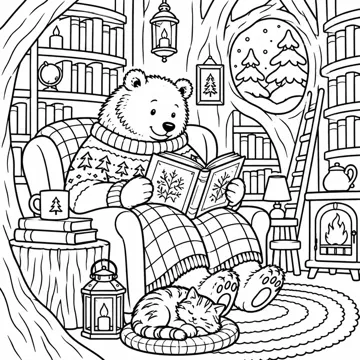
In the heart of the forest stood a library run by Berta, a bear with a calm voice. Her neighbors came to find books and tell her which stories had kept them company.
Every autumn, Berta closed the woodland library for her long rest. She left a returns box beneath the eaves and a sign giving an approximate spring opening date. This year, just after putting away the ladder and folding her blanket, she found a blue book on the counter. It had no title and no library card. On the first page was a bridge drawn in green ink.
The bear knew every book in her library, including the atlas with a missing island and the cookbook where somebody had written too much salt. She did not recognize this one. In the middle she found a river. On the last page was a lighted window. The story was written in several different kinds of handwriting, some tiny and some leaning steeply to the right.
Berta could have put it aside until spring. But the returns box had a crack, and the winter promised snow. If someone came looking for the book, there would be nobody to return it. She decided to open for one last afternoon. She lit the entrance lamp and placed the blue volume beside a sheet of paper: does anyone know this story?
Three memories
Ulysses the badger arrived first. He recognized the bridge immediately. 'It's the story about the carpenter who builds a crossing over the river,' he said. According to him, it ended when the carpenter crossed to visit his brother. He remembered the smell of wet timber and an argument about how many nails were needed. Berta wrote his name on the sheet.
Next came Celia, a squirrel in an overlong scarf. She recognized the bridge too, but insisted there was no carpenter. 'It's about a girl carrying a seed to the other side,' she said. The river rose, and the girl had to wait three days. Celia distinctly remembered the seed being kept in a button box. Berta added that beneath the first memory.
The third visitor was a crow. In his version, the bridge was for listening rather than crossing. A musician sat underneath it because the water made a special sound there. Eventually he discovered a tune he could not play indoors. All three visitors studied the book. They could not be describing the same story, yet each recognized the green mark on its opening page.
Ulysses suggested that someone had replaced the pages. Celia wondered whether there were three identical books. The crow suspected the others had unreliable memories. Berta raised a paw. 'Let's read it before we decide who is mistaken.' She pulled up four chairs, set the teapot well away from the papers and opened the book at the beginning.
The stitching
The first part was indeed about a carpenter. He built a bridge to visit his brother but ended up inviting the whole village to use it. Ulysses smiled triumphantly. Berta read on. The next page began many years later, when a girl found a seed in the carpenter's empty house. Celia leaned forward. The seed traveled inside a button box.
Farther on, the tree that grew from that seed shaded a musician. Sitting among its roots, he listened to the water passing beneath the bridge. The crow opened his beak in surprise. His tune was there too. None of them had invented their memories. Each knew a different part of the book, and each part began where another seemed to end.
Berta examined the spine. It had not been stitched all at once. Red, blue and yellow threads held separate bundles of pages together. In a margin she found a date from many winters ago. Beneath it, in her grandmother's handwriting, was an instruction: whoever borrows this may add a path, but must return it so that someone else can continue.
Then the bear remembered afternoons when her grandmother carried a notebook from house to house. She had never seen it finished because it had no fixed ending. Neighbors added a scene, let the ink dry and lent it onward. Over the years it had returned so often that someone had given it blue covers to keep it safe.
The blank page
One question remained: who had left it that morning? They examined the final scene. The lighted window belonged to a house where a traveler found shelter before the snow. There was no signature. The last sentence said she carried important news, but the following page was blank. Ulysses wanted to know the news. Celia suggested the birth of another tree. The crow preferred a song.
Berta looked out of the window. Afternoon light was fading, and she was very sleepy. She could write the news herself and finish the matter. But this book had traveled so far because nobody had decided everything for everyone else. She found a wooden box, checked that its lid closed tightly and placed it beneath the eaves beside the cracked returns box.
Inside she put the notebook, some pencils and a new note. She explained how the book worked. Each visitor could add a scene after reading what came before. It did not have to be long, but it should respect the characters already there. She also asked that nobody leave the notebook outside its box in rain or snow.
The three friends offered to look after it. Ulysses would mend the eaves. Celia would bring fresh pencils. The crow would let them know if snow covered the entrance. Berta realized she did not need to stay awake for the library to keep one small door open. She gave them the box key, tied to a wide cord that would hang from the post.
A library awake
Before closing time, a young hare came to the counter. She apologized for leaving the book without waiting. She had found it at her aunt's house and added the traveler's scene, though she was not sure she was allowed. Berta showed her Grandmother's handwriting. The hare read it twice and asked whether she could finish the news. 'Of course,' said the bear. 'But read what the others add first.'
That night, Berta put out the lamps, closed the windows and settled in her upstairs room. She heard Ulysses fitting a board beneath the eaves. Then came the box lid, the scratch of a pencil and a quiet conversation. These were not sounds that required her to get up. They were the sounds of something that could continue without her.
When spring arrived, the notebook had orange thread along its spine. The traveler's news had led to a garden, the garden to a station, and the station to a house beside the sea. Berta put the kettle on and began to read. On the first new page she found a simple dedication: for the librarian, when she wakes. Beside it, someone had drawn a very comfortable chair.
The end