Six o'clock exactly
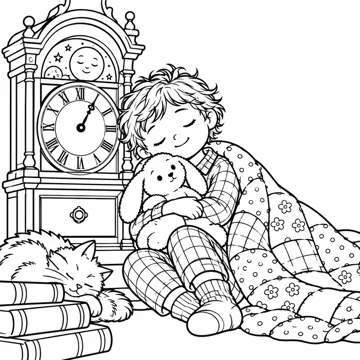
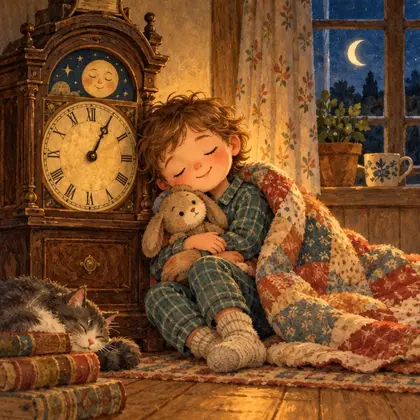
The clock came with the house. It was a tall case clock, taller than Ivo, with a glass door and a brass pendulum that swung to and fro without hurrying. It had belonged to Great-grandmother Amparo, like the bookcase in the hall and the armchair where his father now sat reading.
It kept good time, except for one thing. Every afternoon, at six o'clock exactly, it stopped. The pendulum hung still in mid-swing. Five minutes later, with nobody touching it, it started again. And the strangest part was that it did not run late: at five past six it said five past six.
'It's old,' said his father.
'It's broken,' said his sister Vega, who was seven and had an opinion on everything.
Ivo did not agree with either of them. A broken clock stops at any old time, not always at the same one. This looked as if it had been done on purpose, and things done on purpose have a reason.
He wrote it down in his notebook for two weeks: time stopped, time started. Fourteen identical lines. With the notebook in his hand, he talked his father into phoning the clockmaker.
One wheel too many
The clockmaker was called Matías and he arrived with a case full of tiny screwdrivers. He opened the clock, fitted a magnifying glass into his eye and said nothing for a long time. Ivo managed not to ask questions, which was the hardest part.
'Nothing's broken in here,' Matías said at last. 'Come and look.'
He pointed to a small toothed wheel, made of paler metal than the rest. It had one single long tooth.
'This wheel didn't come from the factory. Somebody added it. It turns once every twelve hours and, when the long tooth reaches the top, it holds the pendulum. Meanwhile the works inside go on counting. That's why the time is right afterwards.'
'Who does that to a clock?'
'Somebody who wanted it to stop.' Matías took the glass out of his eye. 'See what's engraved on the rim.'
Ivo leaned in. In very small letters it said: 'So I can sit down. A.'
His father, in the armchair, was quiet for a moment. He told them that Great-grandmother Amparo had raised five children, run a haberdashery and never stopped all day. But at six in the evening, whatever was happening, she sat down by the window. Her children knew that for that little while nobody asked her for anything.
'I can take it out in ten minutes,' Matías offered. 'And you'll have a normal clock.'
Ivo looked at his father. His father looked at him.
'Can we think about it?' said Ivo.
Five minutes
That afternoon, at one minute to six, Ivo sat on the floor in front of the clock with the old bear he no longer admitted to owning. Vega sat beside him because she did not want to miss anything. Their father closed his book with one finger inside.
The pendulum stopped.
During the first minute, Vega asked three times whether they were allowed to talk yet. During the second, Ivo noticed that his leg itched. Without the ticking, the house made other noises: the fridge, a pipe, rain starting in the yard.
In the third minute he stopped waiting for it to be over. The light from the window had turned orange and was climbing slowly up the wall. He had never seen it climb. He was always doing something else.
The pendulum started by itself. Tick.
'I've thought of a drawing,' Vega announced. 'A horse in boots.'
'I heard the rain,' said their father, as if that were news.
They did not take the wheel out. It did not become a rule either: there were afternoons of homework, of dentists or of rushing, and the clock stopped for nobody. But when they were at home, one of them would say 'it's nearly six' and the others would drift into the hall.
Weeks later, Ivo took a drawing of the mechanism to school to explain it. A girl in his class put her hand up.
'So for five minutes a day you do nothing.'
Ivo thought about his answer. He remembered the horse in boots, the rain and the light on the wall.
'It's not doing nothing,' he said. 'It's not doing something else.'
At home, he wrote a card and stuck it inside the glass door, in case the clock ever belonged to somebody else: 'It isn't broken. It stops at six so you can sit down. I.'
The end