A page set aside
Lucía had set aside a whole page of her notebook for shooting stars. At the top she had written, with a ruler and a felt pen: 'Perseid meteor shower. Total: ___'. Underneath she had drawn boxes to tick them off in fives, the way bird counters do.
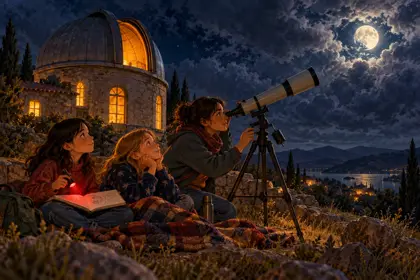
She had been getting ready for a week. Her grandfather had covered her flashlight with red paper, because red light does not spoil your night vision. She had talked Julia into coming to the village observatory by promising her, in these exact words, 'the best show of your life'.
They arrived at ten. At a quarter past ten, the clouds arrived.
They were not storm clouds. They were worse: a thin layer, like a bedsheet, covering everything without ever making up its mind to rain. Ada, who ran the observatory, came out of the dome with a blanket under her arm.
'It might clear and it might not,' she said. 'In astronomy, this is half the job.'
'What is?'
'Waiting without knowing.'
A light that blinks
They spread the blanket on the grass. Julia lay on her back, perfectly calm, and started eating sunflower seeds. Lucía could not keep still. She looked at the empty page and then at Julia, and felt she owed her something.
At twenty to eleven, a light crossed between two clouds.
'There!' Lucía switched on the red flashlight and ticked the first box so hard she almost tore the paper.
'What was it like?' asked Ada, without raising her voice.
'A light. Going across.'
'Fast or slow?'
Lucía thought. She had had time to point at it, shout and switch on the flashlight, and the light was still there.
'Slow.'
'Steady or blinking?'
'It was blinking,' Julia admitted from the blanket. 'Red and white.'
Lucía knew what it was before anyone said so. A plane. She looked at her ticked box. It was the only one on the whole page, and rubbing it out made her furious.
'Don't rub it out,' said Julia. 'Make two columns. Put what you saw in one and what you think it is in the other.'
Lucía drew a line from top to bottom. On the left she wrote: '10:41 pm. Slow light, blinks red and white.' On the right: 'Plane, almost certainly.' It surprised her that the page no longer looked like a failure. It looked like a real notebook.
What was there
Close to midnight the sheet of cloud tore along one side and the moon appeared, nearly full. With that much moon there would be no shooting stars, Ada explained, but there would be something else. She opened the dome and swung the telescope around.
Lucía looked first. She expected the moon from pictures, smooth and yellow. What she saw was an edge crowded with craters, each with its own long shadow, so sharp that she took her eye from the eyepiece to check it was not a photograph.
She drew what she could make out: three large craters, a chain of mountains, a dark patch. Where she could not see, she left the paper blank. It was hard. Her hand wanted to fill it in.
Julia looked next and drew the same thing on her sunflower-seed napkin. They compared. They had observed the same piece of moon and the two drawings did not match: Julia had seen four craters and no mountains.
'One of us is wrong,' said Lucía.
'Or neither,' said Ada. 'That's why you look more than once, and why more than one person looks.'
The clouds closed again at one o'clock. They had not seen a single Perseid.
On the way home, Lucía apologized to Julia about the best show of her life. Julia stared at her as if she were speaking another language.
'We saw mountains on the moon,' she said. 'With shadows.'
At home, before bed, Lucía finished the page. Where it said 'Total' she wrote a zero, good and clear. Underneath she added: 'One plane. About three or four craters (check). Go back on the 14th, no moon.' Then she switched off the red flashlight. There was not a star to be seen from her window, and she did not mind.
The end