The wrong moon
Moths steer by the moon. They do not follow it: they keep it on the same side as they fly, and that way they travel in a straight line. It works very well with a light that is enormously far away. With a light that is close, though, the straight line turns into a circle, and the circle into a spiral that keeps tightening.
Mirta could not have explained it in those words, but she had seen it many times. She lived in the lighthouse garden, among the honeysuckle, and every night some young moth set out to look for flowers and ended up circling the staircase window. They circled until dawn. By morning they were so tired they could not even fold their wings.
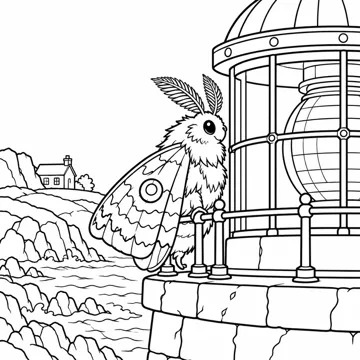
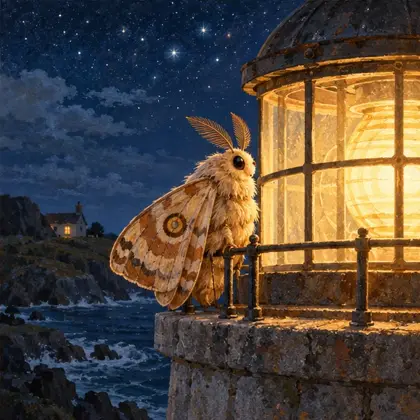
The great lamp at the top was not the trouble. It swept the sea so high and so fast that no moth mistook it for anything. The trouble was that small window halfway up, where a still, yellow light leaked out. It faced straight onto the garden.
Mirta would settle on the railing and call to the young ones from there, and sometimes one of them heard her. Most did not. Then she stayed until daybreak, keeping watch, in case she could lead even one back to the flowers.
Count before you ask
One moth cannot keep watch every night of a summer. Mirta understood that on the morning she fell asleep on the railing and was very nearly eaten by a sparrow.
She decided to do something else: count. For six nights she called to nobody. She only watched. She kept a record in her own way, with grains of pollen on a flat stone, of how many moths were lost and where they came from. By the sixth day the stone said it plainly: nearly all of them came from the honeysuckle side, and nearly all were caught between dusk and midnight, when the keeper went up and down the stairs with the light on.
The hardest part was left. The keeper was a quiet man who wrote in a notebook every night, beside that very window. Mirta could not speak to him. But she could make herself noticed.
The first night she landed on his page, right on the date. He moved her gently aside. The second night she came back, and the third. On the fourth, the keeper put down his pencil and followed her with his eyes to the glass. On the other side, six moths were circling without rest. On the sill lay as many again, worn out.
'Ah,' said the man. 'It's the light.'
The next evening he hung a thick canvas curtain over the window. The lamp at the top went on sweeping the sea, and the ships noticed no difference. The garden, for the first time in many years, was completely dark. Above it the moon came up, the real one.
Signals that don't depend on one moth
That did not fix everything. Some nights the keeper forgot to draw the curtain. On others there were clouds and no moon to be seen. Mirta thought of something that would work even without her: she marked the stones of the path with yellow pollen, one arrow after another, from the lighthouse to the honeysuckle.
The arrows lasted until the first rain.
Mirta made them again. It rained again. She made them a third time, and then a young moth, one of those she had coaxed away from the window weeks before, settled beside her.
'Why are you doing it all by yourself?'
Mirta did not know what to answer. It had never occurred to her to ask.
From that night on they took turns. Some renewed the arrows. Others learned which flowers opened at which hour and taught the newcomers to follow them by scent, which works with no moon and no pollen. Mirta discovered that some of the young ones could smell jasmine from a distance she could no longer manage.
She saw the proof one night of thick fog. You could not see the moon, or the arrows, or the railing itself. Mirta thought all the work had been for nothing. But the young moths went out anyway, slowly, from flower to flower, calling to one another. Not one was lost.
Mirta heard them go by from under a leaf, where she had sheltered from the damp. It took her a moment to notice something odd: she was not keeping watch. It was the first night of the summer she had not kept watch.
She still flew up to the lighthouse now and then, out of habit and because you could see the sea from the railing. The keeper recognized her, or seemed to, because he lifted one finger from his notebook by way of hello. But she no longer stayed until dawn. She went down to the garden before midnight, found an open honeysuckle and let the night go on without her.
The end