Three toes in the rock
Tara had crouched down to tie her shoelace, and that was how she saw it. The rest of the class was already ahead, following the teacher along the dry riverbed.
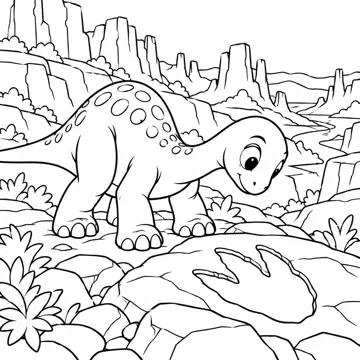
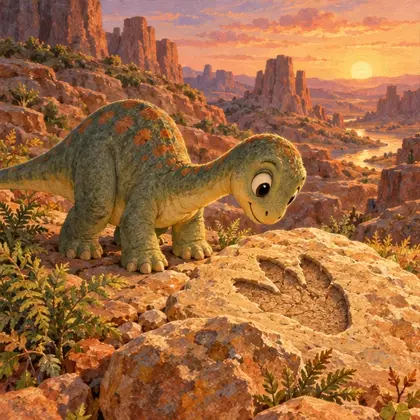
It was a hollow in the rock, bigger than her backpack, with three long toes ending in points. Last night's rain had filled it with water and, shining like that, it could not have been clearer.
'Miss! MISS!'
They all came running back. Miss Elena flung her arms wide before anyone could get too close.
'Stand still. The first thing you do when you find something like this is not tread on it. The second is look properly. Tara, you found it: what can you see?'
What we know and what we don't
Tara took out her ruler and her squared notebook. She measured the footprint: forty-two centimeters long. She drew it square by square. At the left-hand toe she hesitated, because it was shorter than the others.
'Maybe it had a bit of toe missing,' said Dani.
'Or the rock has worn away on that side,' said Tara.
'Which one is it?' asked the teacher.
Tara looked at the footprint for a long time. There was no way to tell.
'Then write it down like that,' said Miss Elena. 'A question mark in the right place is worth more than a made-up toe.'
Tara drew the short toe exactly as it was and put a question mark beside it.
A few steps on there were more footprints, in a line, each nearly two meters from the last. And beside them, half worn away, were much smaller ones, the size of Tara's hand, with three toes as well. There were lots of them, close together, because it takes many little steps to keep up with one big stride.
A big one and a little one
The picture came into Tara's head without her asking: a small dinosaur trotting next to an enormous one along a riverbank, a very, very long time ago. The little one stopped to look at the footprint the big one had just left, so deep that it could have fitted right inside. Then it ran to catch up.
'They were a mother and her baby,' she said out loud.
'They might be,' said the teacher. 'What else could they be?'
Tara thought. They could be two different animals that passed on the same day. Or on different days. Mud does not tell you who was walking with whom.
She wrote it all in her notebook, in two columns. In one she put 'What we see': big footprints, small footprints, same direction. In the other, 'What we imagine': a baby with its mother. She liked the second column better, but she understood why they had to be kept apart.
Dani had found a loose stone with one small footprint on it and wanted to take it home.
'If you take it, nobody will know it was next to the big one,' said Tara. 'And then it stops telling the story.'
Dani put it back where it was. They took photos with the ruler beside each print, drew a plan of the path and ringed the tracks with stones so that nobody would step on them. The teacher phoned the museum then and there.
A month later a letter came to the school. The museum people had put up a fence and a sign. It said: 'Dinosaur footprints. Possibly an adult and a young one. Found by Class Three.' The word Tara liked best was 'possibly'.
The end