The key among the roots
Behind the palace stood a wall so covered in ivy that nobody remembered it was a wall. People called it 'the green side' and walked on by.
Clara came across the key by accident, on a day when she was hunting for worms for her compost bin. It lay among the roots, black with rust, as long as her hand. A key that big had to open something big.
It took her a week to find the lock under the ivy, and half a morning to make it turn with oil from the kitchen.
On the other side was a garden. Or what was left of one: paths wiped out by leaves, a dry fountain with a stone bird, rose bushes gone to bramble. On the far wall somebody had painted letters you could still read: 'This garden belongs to whoever looks after it.'
Clara wanted to start pulling up weeds that very instant. She had her hands on the first clump when she smelled mint. That was no weed. She sat on the edge of the fountain and decided to look before she touched.
Look before you touch
She spent three afternoons walking the garden with paper and pencil, pulling up nothing. She drew what was still alive: the mint, a pomegranate tree, two rose bushes that still gave small flowers. She marked a blackbirds' nest in the bay tree and a hedgehog's burrow under the woodpile. They had been there before her.
A garden like that could not be mended by one person, not even a princess with good boots. Clara opened the door wide, nailed up a sign and waited.
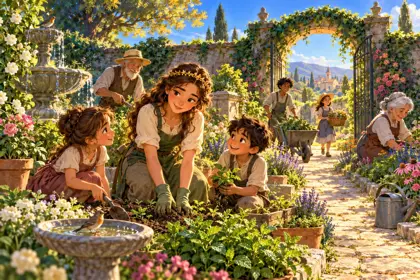
On the first day eleven neighbors came, and each brought a different idea. A boy wanted a swing. The baker wanted a bed of herbs for her bread. The carpenter wanted a shady corner for his nap. Two sisters argued over roses or dahlias.
Clara started answering everybody at once, faster and faster, handing out yeses and noes as though the garden were hers. Halfway through a sentence she heard herself and stopped. She looked at the letters on the wall.
She took out her drawing, spread it on the edge of the fountain and put pebbles on top.
'One pebble each,' she said. 'Put it where your thing would go. Then we'll see what fits.'
The pebbles for the swing and the shade landed in the same place, under the pomegranate tree. It turned out they did not get in each other's way. The roses and dahlias did, until Grandma Remedios, who had not said a word yet, pointed with her walking stick.
'Before the flowers, the path. With that track I can't even get as far as the fountain.'
Whoever looks after it
So the path came first. They made it wide and smooth, of beaten earth, so that a walking stick, a pram and a wheelbarrow could all get along it. It took two weeks, and in all that time not one flower was planted. Some people grumbled. Remedios, on a chair by the door, kept telling them where there were still stones.
After that came everything else. The grown-ups mended the fountain; the stone bird spouted water from its beak again. The baker planted thyme. The swing was hung from the pomegranate tree. Clara dug, carried and got blisters on her hands just like the rest.
There was one problem nobody had expected: the blackbirds drank the water from the seed trays and ate the seeds while they were at it. The carpenter suggested a scarecrow.
'They were here first,' said Clara. 'They're on my drawing.'
They put a clay bowl well away from the seed trays and filled it every evening. The blackbirds preferred the bowl. The hedgehog, on his own account, took care of the snails.
By early summer the garden did not quite match the drawing. It had a swing nobody had drawn and one crooked bed. It had dahlias and roses, both, because in the end there was room.
Clara left the big key hanging on a nail, outside the door, where anyone could take it. She went over the letters on the wall with fresh paint, because they were fading.
On the first hot night, half the village came out to enjoy the cool air there. Remedios walked all the way to the fountain on her own two feet and sat on the edge. Clara lay on the grass, her blisters dry by now, and listened to the water, the swing and the blackbirds until her eyes closed.
The end