Inés's plan
The lantern festival was held on the first night of spring, and that year Inés was in charge. She had asked to be. She was nine years old and she had a notebook full of drawings and a plan.
The plan filled four pages. A hundred and twenty paper lanterns hung from the railing of the bridge, arranged by color like a rainbow: red at one bank, violet at the other. White ribbons from lantern to lantern. All measured.
'I could make some bunting,' the seamstress offered.
'Thank you, but it isn't in the plan.'
'The little ones would like to cut out shapes,' said the schoolmaster.
'Next year, perhaps.'
The ferryman tried to tell her something about the wind off the river, but Inés was already running to the far bank with a ladder.
She worked for three days. On the afternoon of the festival, the bridge looked exactly like her drawing. Inés gazed at it from the square, her hands covered in glue, and thought she had never seen anything so lovely in her life.
The wind off the river
At seven o'clock, just as people were starting to leave their houses, the wind came.
It was the river wind, the one that blew most spring evenings along the north side of the bridge. The ferryman knew it very well.
It lasted a minute. It tore half the paper shades. It tangled the white ribbons into one enormous knot. Two lanterns broke loose and fell into the water. The bridge keeper put out every candle, one by one, before any of them could set the paper alight.
Inés stood in the middle of the dark bridge with a broken ribbon in her hand. She felt the tears coming and turned away so that nobody would see.
Her friend Mar arrived with a stool and sat her down on it.
'Cry a bit if you want,' she said. 'But then ask. There are a lot of people here who know things.'
Inés blew her nose. Asking was exactly what she had not done for three days. She lifted her head. At the end of the bridge the villagers were waiting, not sure whether to go home.
'It's all broken,' she said, loudly enough to be heard. 'I can't fix it on my own. What would you do?'
A hundred and twenty different lights
For a moment nobody spoke. Then everybody spoke at once.
The carpenter had fruit crates in his workshop: with a hole in each side they would shelter the candles from the wind. The seamstress went for her leftover cloth and cut short bunting, the kind that does not tangle. The schoolmaster handed out scissors so the little ones could cut shapes in the crates. The ferryman pointed to the south side of the bridge.
'It doesn't blow there. Hang the paper ones that survived on that side.'
'That's what you wanted to tell me on Tuesday,' said Inés.
'That's the very thing,' said the ferryman, without any crossness.
The baker carried her long table out into the square to work on. Inés did not direct anything. She sanded crates, held candles and passed the glue. When anyone asked her where something should go, she answered, 'Where would you put it?'
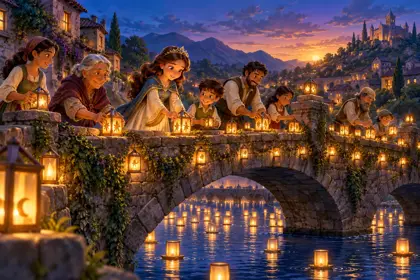
The festival began an hour late. There was no rainbow. There were fruit crates with stars cut into them, and fish, and a lopsided cat made by a four-year-old. Each one threw its shadow on the stones. The paper lanterns glowed on the south side, quite calm, and their lights trembled in the river.
The villagers crossed slowly, looking for their own crate. 'That one's mine.' 'My sister made that fish.'
'It's prettier than your drawing,' said Mar.
'It's prettier than my drawing,' Inés admitted, and it stung less than she expected.
That night she did not throw away her four-page plan. She turned it over and, on the back, wrote down the names of everyone who had helped. There were forty-one. At the top she wrote: 'Ask on Tuesday, not on Saturday.'
The end